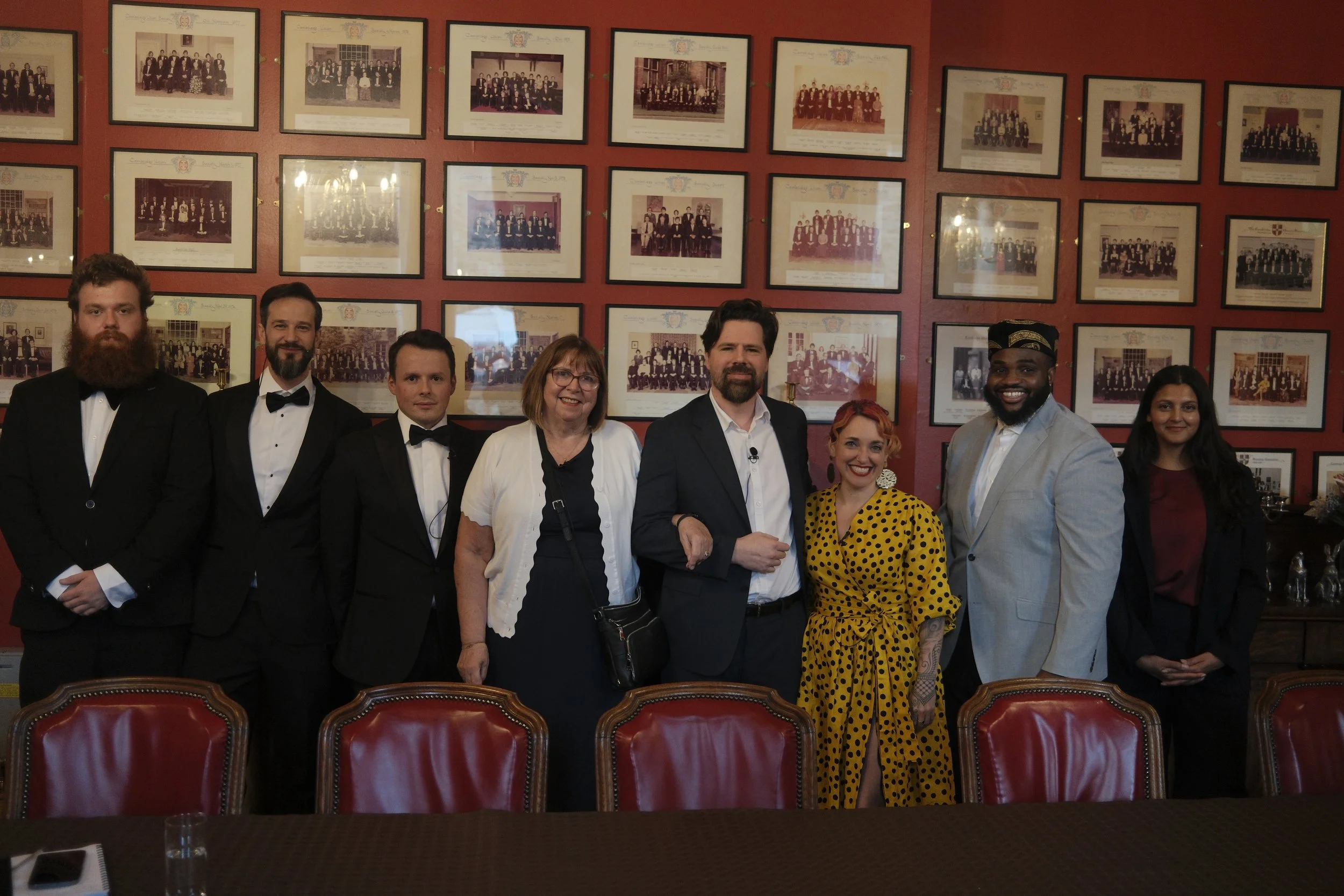
The Opposition (left) and Proposition (right) with Prof. Dame Wendy Hall and MSt cohort member Daniel Rathwell.
Last week, I participated in the first (and hopefully inaugural) MSt in AI Ethics & Society Debate at The Cambridge Union. And, thrillingly, our team won!
The Motion was: This House believes that frontier AI safety is a distraction from algorithmic injustice.
I am sure no one is surprised that I debated for the Proposition.
And when we say “won”, we mean something specific: our team was able to persuade more people in the audience to switch their position compared to our opponents. Upon registering, attendees were split 34 to 37, in favor of the Opposition. The final tally was 44 for the Proposition, with 40 for the Opposition. Abstention was also an option.
Traditionally, each side of the debate has 2 speakers, but for our event we chose 3: for the Proposition, 2 current MSt students and a member of the staff at LCFI; for the Opposition, an alum of the MSt program, a Cambridge undergrad, and a Cambridge lecturer (who also happens to be an MSt alum).
What I’m going to do here is provide you a window into the experience, because honestly, it was a ton of fun. Now, if you follow me at all, you know that I just love learning. And when I was admitted into this program (after two years of starting at the webpage and a little nudge from a friend), I promised myself I’d make the absolute most of It. So when my incredible cohortmate came up with this idea and this Motion was chosen, I immediately shot up my hand (per usual, goodness knows I’m always ready to share my opinion).
Some notes, before we begin
Here, I’m going to try to give you some insight into the overall experience. We debated under Chatham House Rules in order to provide the freest possible debate. As a professional program, many of our students have professional obligations that might not allow them to speak freely on such a divisive issue, they might be representing a perspective that doesn’t align with their own, and any of that being taken out of context could be utterly disastrous on Beyonce’s internet. To honour this, I’m choosing not to name the other debaters or their arguments (but they were all awesome, I promise!).
So here, I’m going to give you some context on my remarks, and then share them. I’ve tried to reproduce them as closely as possible to how I delivered them, but my memory is imperfect. I debated with a sheet holding my references and argument structure, but only wrote my positionality statement and closing quip verbatim. In the section where I present my arguments, I’ll also share metacommentary about what I was trying to do with my argumentation. My arguments will be in italics, with my metacommentary below. When debating, I didn’t reference full citations (just researcher last names), but in-text citation format is included here to make it easier to connect to the reference list at the bottom.
I’d ask as you read to consider that this format pushed us to defend a binary position, and compress the argument into a 7-minute speech. While my personal views are certainly pro-justice and critical of much of the frontier AI safety project, I have a much more nuanced view that what’s strictly here – message me to talk about it!
After we cover what I argued, I’m going to dive into how the Proposition team prepared for the debate. Partly, in the hopes that it’s useful to future MSt debaters (inshallah), but also because I think it was an incredible experience of people collaborating really seamlessly: bringing their unique perspective and skills together to produce something really fabulous. Truly, it felt like a Dream Team, and I am so grateful to have been a part of it.
Alright, let’s dive in.
Ready speaker one
Frontier AI safety is a distraction from algorithmic injustice.
I ground the debate in the opening claim, which then needed to be directly contested by the Opposition. I stated it in a register as if it is objective truth, rather than a contestable claim.
I offer my arguments not just as a scholar of AI ethics, but as an activist executive and venture capitalist who has spent over 13 years in the high tech industry and personally gone toe to toe with figures like Alex Karp and Demis Hassabis on equity issues. I carry the legacy of both my English ancestors, who perfected colonial capitalism and the legacy of resistance and refusal of annihilation of my Yaqui ancestors with me today.
I open with a positionality statement that claims epistemic authority in multiple registers, with the goal of gaining the upper hand regardless of how any particular audience member might construct their hierarchy of epistemic authority. I start with my academic credentials, appropriate given the setting at a university. Then, I speak to my professional experience in positions the technology industry values, and assert that I am not just any tech executive: I’m one that has already challenged the industry’s leading figures on these issues. Then, I state the authority of my situated knowledge and ancestral inheritance, as a descendant of the two “sides” of the colonial superstructure I will claim the entire debate exists within. Perhaps not obvious to those in the room, that last statement is also naming the medicine I bring with me in this work, referring to the holistic, sacred force in Native American tradition that restores harmony, balance, and connection among mind, body, spirit, and community. Claiming medicine in a colonial, historically eugenicist institution like Cambridge is itself meant to be an act of resistance and position me as someone who has intentionally ideologically aligned myself with one side of the debate.
Now, we define our terms.
Frontier AI safety is a practice grounded in harm reduction that seeks to reduce the risk of catastrophic, existential harm caused by the ideological project driving the creation of the most advanced AI technologies.
Algorithmic injustice describes the material, ongoing harms produced by the mainstream AI industry, that disproportionately accrue to the already marginalised, as documented by Couldry & Mejias (2019) and Hao (2025), among others.
Distraction refers to both the narrative construction of what risks and harms are most important and urgent, and the material consequences in terms of financial and institutional support directed to prevent or resolve them.
By offering definitions, I am requiring the Opposition to challenge the ideas I’ve first put in the room. The most important is probably that I call AI an ideological project, which sets up my first real argument.
Frontier AI safety exists within a White supremacist, capitalist superstructure that reproduces colonial, extractive logics. “AGI” and other frontier concepts are an ideological construct, lacking a technical definition or specified engineering goals (Gebru & Torres 2024). Helfrich (2024) shows that “frontier AI” is largely a marketing term that can be traced back to effective altruism-aligned actors that serve their interests. Leslie et al. (2024) has shown that the urgency and inevitability framing constant in AI safety discourse outpaces both its governance achievements and technical substance.
Frontier AI safety is preoccupied with theoretical, largely optional risk while algorithmic injustice seeks to address present, measurable harm. Tallinder, Stephens, and Vanderslott (2025) show how frontier safety uses technoscientific expertise as a legitimating strategy. Most fundamentally, frontier AI safety fails to ask the most basic ethical question: “Should we?”
But algorithmic injustices are documented and pervasive:
Computer vision recognises dark-skinned women at rates shockingly lower than light-skinned men, as documented in the Gender Shades paper (Buolamwini & Gebru 2018).
Healthcare algorithms provide lower levels of care to Black patients who are equally as sick as White patients (Obermeyer et al. 2019).
AI regularly misgenders trans people (Keyes 2018), and I will never forget how my Korean ex-wife had to go through manual passport control in Sydney because the biometric scanner simply could not recognise her eyes as open.
The COMPAS system is a known site of errors in recidivism rates, replicating existing institutional racism in the criminal justice system (Chouldechova 2017).
That is to say nothing of the known issues with degradation of knowledge worker epistemic agency and cognitive capacity, labour exploitation among data workers predominantly in the Global South, and rampant ecological damage committed by frontier AI.
Here, I have tried to provide a broad survey across domains of the kinds of harms that are happening, and across multiple dimensions of marginalisation. While most of my arguments are grounded in the literature, I also include a personal story to connect more emotionally with the audience. A few folks close to me audibly breathed in when I described the failure of Australia’s biometric system, which was precisely my goal. It absolutely sucked at the time.
Massive funding flows to AI safety from powerful finance and technology figures and institutions. Effective altruism-aligned Open Philanthropy has spent more than half a billion dollars on AGI while billions have been spent otherwise on AGI-related projects (Gebru & Torres 2024). Lazar and Nelson (2023) have shown that firms cut teams focused on present harms–like Culture Amp eliminated my team entirely over the course of 18 months–while expanding “safety” budgets like the UK's £100 million Foundation Model Taskforce. AI safety is also increasingly captured by corporate interests: Birhane et al. (2022) documents that corporate affiliation among FAccT proceedings rose from 24% to 55% between 2008 to 2019, while keywords prioritised performance and efficiency over concepts like justice and inclusion.
We also cannot ignore the eugenicist nature of many of the elite and funders of the AI safety project. Gebru & Torres (2024) have documented how the TESCREAL Bundle, including effective altruism, are grounded in eugenicist logics. Nick Bostrom (2005), certainly a supporter of AI safety, has situated transhumanism within the eugenicist tradition, and Kessler (2024) traces funding links between longtermist funders and safety-branded lab Anthropic.
While I constructed this argument before I knew who was debating for the Opposition, once I met the team these became even more useful. One member of the Opposition personal aligns with the effective altruism movement, and invoking such a strong claim, I thought, might emotionally destabilise him a bit. Bit of a cunty move, but the point is to win.
Now, am I suggesting that everyone involved in AI safety is a eugenicist? Of course not. What I am suggesting is that this group is not practiced in the critical reflexive practice that would be required to interrupt these foundations, and that’s not unrelated to how homogeneous the field is. West, Whittaker, and Crawford (2019) have reported on the homogeneity among leading AI labs. Fundamentally, this means that the field is epistemically impoverished: Fricker (2007) traces how a narrow epistemic base produces blindspots where the field simply fails to consider, understand, or address existential threats to those not represented. Harding (1993) suggests that the marginalised perspective is actually more valid and objective, because it can see, anticipate, and properly weigh the scope of harms for the global population.
Again, I didn’t know who I was debating when I constructed this argument, but the Opposition handed me something here. While I won’t speculate on each team member’s specific identity, they appeared to all be White men. In contrast to the Proposition team representing Latina, African, and South Asian backgrounds, we visually backed up the claim about our own epistemic authority. Bit of a gimme, or a luck of the draw. But, I was happy to take it.
Now, I believe that these people are well-intentioned, but so were the missionaries that colonised the Americas and enabled genocide against its Native peoples. You can’t reasonably argue that their intentions are an excuse. That is, existing in an epistemic kiddie pool with pure intentions does not absolve the AI safety community of the moral responsibility of enabling the agenda of the powerful who have explicitly articulated that genocide of everyone who does not resemble Sergey Brin is an acceptable tradeoff because they’ve read too much Isaac Asimov. It is not acceptable.
In closing, I call back to the colonial history that I’ve claimed still operates today, and recall my personal relationship to that ongoing history. I’m nearly absurdist in comparing AI safety researchers to missionaries: the room will know the atrocities committed in the name of Christian expansion, and there’s no real normative argument genocide is ever ethically permissable. The references to Sergey Brin (a known transphobe) and the quip about Asimov is meant to suggest that the culture of the field is both tolerant of discrimination and obsessed with science fiction over the real world. I end with a normative claim in the same objective register I opened with, implicitly claiming my perspective as more objective, having referenced Harding as my anchor.
How the Proposition prepped
Now, I definitely love winning. But honestly, preparing with such a fantastic team was just a delight. First, we had to decide the speaker order. I researched the function and role of each speaker, and we picked which we thought suited (and we each had a different preference):
First: Define the motion, set the frame, present primary arguments
Second: Rebut the Opposition, defend the initial arguments, present secondary arguments
Third: Rebut remaining Opposition points, resolve central clashes, and summarise without introducing new arguments
We created a Google Doc, where I first summarised my key arguments with supporting citations. The team jumped in, providing feedback and suggesting additional framing and citations to strengthen my opening. Then, we repeated the process for the Second and Third speakers.
What I think made a real difference was an idea presented by our third speaker. She suggested we work together to brainstorm all of the arguments that we thought the Opposition would offer, and document the rebuttals with citations. She even did a bit of oppo research on their academic work (where it was available) to try to anticipate the frame that they might argue from.
That last step, I think, made the difference. Our team had already thought through, and could easily reference, evidence to counter just about everything we expected to come up.
Ultimately, it worked.
A little moment for the dress
If you’ve read this far, you’ve probably got the point that I’m a lot. I am someone who loves dressing up, but who deeply believes that aesthetics and fashion are deeply political. The event called for black tie for the speakers, and so I chose a gown from Nigerian-born, Manchester-based designer M.A.DKollection, and paired that with a pair of earrings from an Aboriginal jewelry maker. Arguing for the prioritisation of globally marginalised communities while representing them visually.
Reference List
Birhane, Abeba, Pratyusha Kalluri, Dallas Card, William Agnew, Ravit Dotan, and Michelle Bao. 2022. "The Values Encoded in Machine Learning Research." In Proceedings of the 2022 ACM Conference on Fairness, Accountability, and Transparency (FAccT '22), 173–184. New York: ACM. https://doi.org/10.1145/3531146.3533083.
Bostrom, Nick. 2005. "A History of Transhumanist Thought." Journal of Evolution and Technology 14, no. 1: 1–25.
Buolamwini, Joy, and Timnit Gebru. 2018. "Gender Shades: Intersectional Accuracy Disparities in Commercial Gender Classification." Proceedings of Machine Learning Research 81: 77–91. https://proceedings.mlr.press/v81/buolamwini18a.html.
Chouldechova, Alexandra. 2017. "Fair Prediction with Disparate Impact: A Study of Bias in Recidivism Prediction Instruments." Big Data 5, no. 2: 153–163. https://doi.org/10.1089/big.2016.0047.
Fricker, Miranda. 2007. Epistemic Injustice: Power and the Ethics of Knowing. Oxford: Oxford University Press.
Gebru, Timnit, and Émile P. Torres. 2024. "The TESCREAL Bundle: Eugenics and the Promise of Utopia through Artificial General Intelligence." First Monday 29, no. 4. https://doi.org/10.5210/fm.v29i4.13636.
Harding, Sandra. 1993. "Rethinking Standpoint Epistemology: What Is 'Strong Objectivity'?" In Feminist Epistemologies, edited by Linda Alcoff and Elizabeth Potter, 49–82. New York: Routledge.
Helfrich, Gina. 2024. "The Harms of Terminology: Why We Should Reject So-Called 'Frontier AI.'" AI and Ethics 4, no. 3: 699–705. https://doi.org/10.1007/s43681-024-00438-1.
Kessler, Asher. 2024. "Longtermism, Big Tech, and the Rebalancing of Historical Time: A Benjaminian Critique." International Journal of Communication 18: 5363–5381.
Lazar, Seth, and Alondra Nelson. 2023. "AI Safety on Whose Terms?" Science 381, no. 6654: 138. https://doi.org/10.1126/science.adi8982.
Leslie, David, et al. 2024. "'Frontier AI,' Power, and the Public Interest: Who Benefits, Who Decides?" Harvard Data Science Review, Special Issue 5 (September 9). https://doi.org/10.1162/99608f92.4a42495c.
Obermeyer, Ziad, Brian Powers, Christine Vogeli, and Sendhil Mullainathan. 2019. "Dissecting Racial Bias in an Algorithm Used to Manage the Health of Populations." Science 366, no. 6464: 447–453. https://doi.org/10.1126/science.aax2342.
Taillandier, Apolline, Neil Stephens, and Samantha Vanderslott. 2025. "Effective Altruism, Technoscience and the Making of Philanthropic Value." Economy and Society 54, no. 1. https://doi.org/10.1080/03085147.2024.2439715.
West, Sarah Myers, Meredith Whittaker, and Kate Crawford. 2019. Discriminating Systems: Gender, Race, and Power in AI. New York: AI Now Institute. https://ainowinstitute.org/publications/discriminating-systems-gender-race-and-power-in-ai-2.